



President Prabowo Subianto plans to start a fund to drive Indonesia’s transition to a green economy. He aims to raise $65 billion by 2028 from selling carbon credits through reforestation and preservation projects. Peatland and mangrove restoration should be central to these sustainable development solutions. Analysts deem the plan to be ambitious, given the challenges in the carbon market. Globally, nature based carbon credits usually sell at $5-$50 per ton of CO2 equivalent and last year the average was below $10 per ton. The domestic carbon price in Indonesia sits lower, between $2.50-$4 per ton. In 2021, the total amount of carbon credits issued in the global market peaked at 239 million tons1. Even if Indonesia’s government were to sell 200 million tons of carbon credits per year at $50 per ton, they would still fall short of the $65 billion target. Regardless of these constraints, special attention needs to be given to Indonesia’s peatlands, which are estimated to store 28 gigatons of carbon2. Carbon credits are quantified in terms of tons of carbon conserved (avoided emissions) by some verified intervention (usually a certified project). Carbon credits must adhere to rigorous standards and be verified by an authoritative, or accredited agency (either private sector like Verra, or the government). During 2010 – 2016, 40% of GHG emissions in Indonesia were from degraded peatland3. Of the 13.6 million hectares of peatlands in Indonesia, the majority is degraded releasing approximately 55 tons of CO2 per hectare per year4, even more when fires occur. Even relatively intact/pristine ones are emitting 13-20 tons of CO2 per hectare per year. Degraded sites are highly flammable when drained and converted for agriculture or other land use. Although Indonesia’s peatlands are currently a net carbon emitter, there is great potential in generating carbon credits from reducing the rates of their emissions, through management that preserves and restores their carbon storing function. Indonesia is still determining their protocols and standards for the emerging carbon economy, and it is vital to invest in getting the system fit-for-purpose; to reward local people for land-use behaviors that support peatland, mangrove, and forest conservation.
Fires Still Occur in “restored” Peatland
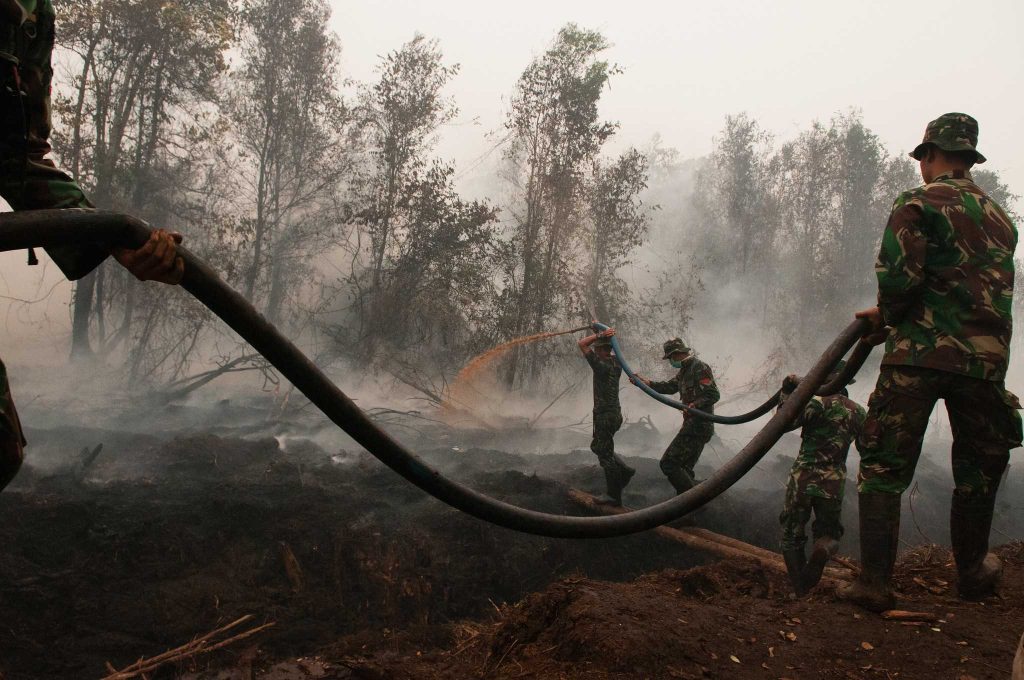
After the fire and haze disaster in 2015, which caused 100,000 deaths in Malaysia, Singapore and Indonesia, the Peat Restoration Agency (BRG) was formed to oversee the restoration of 2.67 million hectares of peatland throughout seven provinces in Indonesia. These areas were known to be highly prone to fires. Their strategy focuses on three things: rewetting, revegetation and revitalization of the livelihoods of the communities that live on those peatlands. As of 2021, Indonesia’s Ministry of the Environment and Forestry (KLHK) claims that 3.66 million hectares of degraded peatland within company concessions have been restored, exceeding the initial target, however this data remains controversial5. Pantau Gambut, an independent peatland watchdog, found 14,437 hotspots in August 20236. A hotspot indicates that an area has a high risk of fire, marked by significantly higher temperatures than the surrounding area. A large number of hotspots were found in palm oil concessions where fires occurred in previous years. Abil Salsabila, a researcher from Pantau Gambut, said that the “repeated burning means there’s still a lack of commitment from companies to restore peatland in their concession and if restoration was done, it wasn’t carried out properly.”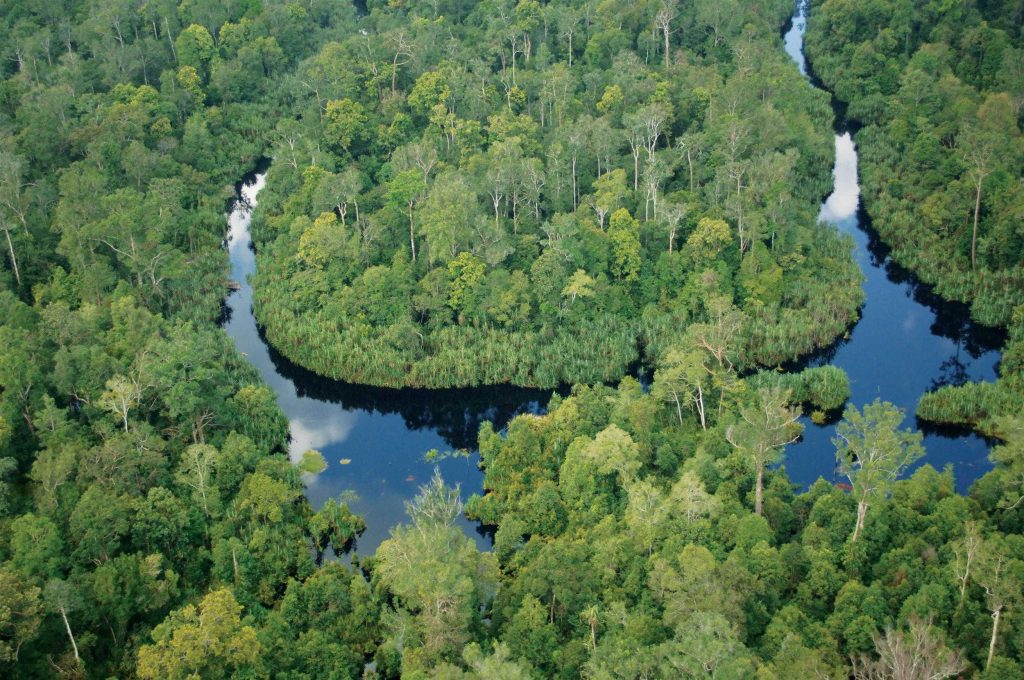
Redefining Peatland Restoration
It seems that the above figure is based on the government’s definition of restoration, which is peatland whose groundwater is at least 40 cm below the surface5. The Gecko Project, a nonprofit newsroom that investigates environmental issues, analyzed the data that KLHK released on the total area of peatland that had a water table of 40 cm or higher since 2018. They found that even by their definition of areas restored, it has never reached the amount that the government claims. During the dry season in June 2022, that figure fell to 500,000 ha. Water levels fluctuate throughout the year, reaching above ground in the rainy season and falling to one meter or more below the surface in the dry season, and even more so during ENSO (El Nino Southern Oscillation) events. More concerningly, latest data indicates carbon release slows when the water-table levels are much closer to ground level (i.e. fully inundated). Peat researchers interviewed by The Gecko Project doubt the reliability of using water level alone as an indicator of restored peatland. While rewetting is an important step, other factors, such as revegetation, should be included in the criteria of restored peat. The relationship between carbon storage and tree recovery on peatlands is complex, requiring active restoration interventions that consider micro-topographical planting strategies. This strategy supports trees taking root on hummocks as the future vegetative providers of peat accumulation, aiming to avoid peat subsidence while maintaining fully wet peatlands.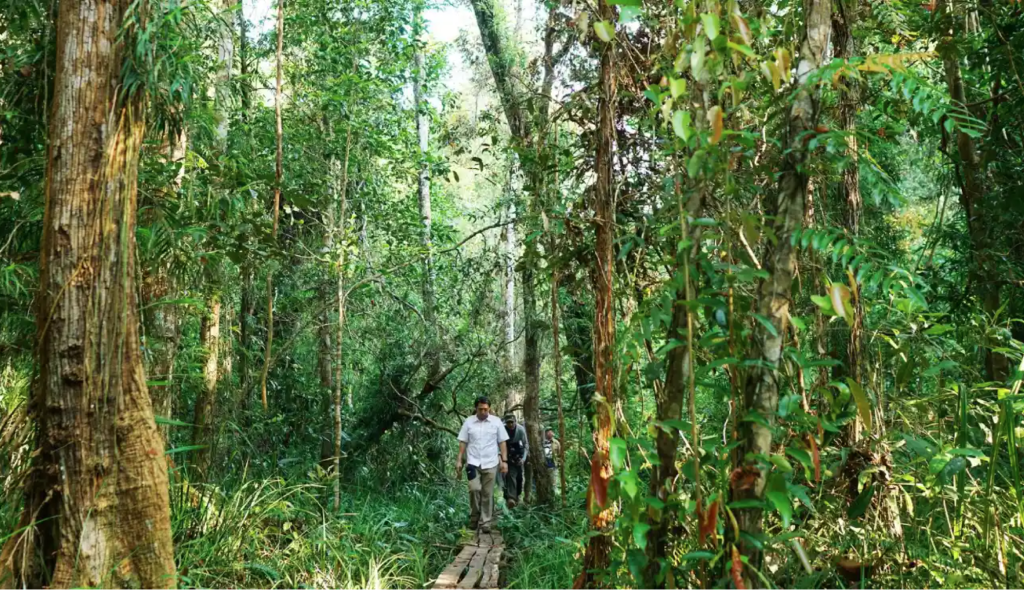
Katingan Mentaya Project
A great example of carbon credit generation from peatland restoration is the Katingan Mentaya Project in Katingan District, Central Kalimantan launched by PT. Rimba Makmur Utama. The project started in 2007 and it took 11 years for the founder, Dharsono Hartono, to see any results. Acquiring the concession license took six years and getting the carbon credits certified and verified took another five years7. Each year, the project issues 7.5 million metric tons of carbon reductions. It is located between the Katingan and Mentaya rivers, encompassing 157,000 ha. There are 35 villages within the concession and the project actively engages the communities by providing them with sustainable livelihoods that suit their needs and are conducive to peatland restoration, which is one of the criteria for high-quality carbon credits. PT RMU must provide assurances that they maintain the free, prior and informed consent (FPIC) of local communities.The fact that peatlands are a major carbon sink, holding twice as much as forests, and that almost half of Indonesia’s GHG (greenhouse gas) emissions are from peatlands, it seems a no-brainer to prioritize their conservation and restoration through the issuance of carbon credits. High-quality carbon credits support peatland’s triple wins of biodiversity, carbon, and community prosperity. As seen in the Katingan Mentaya Project, patience will be required and investment into due diligence, supporting just processes such as FPIC, is necessary. It took PT RMU over a decade to achieve their desired outcomes. If the government hopes to generate carbon offsets from peatland restoration, they should put their money where their mouth is, supporting the long-term development and conservation prospects on the peatlands. These require decadal investment commitments, requiring political appetite for support longer than the usual 5-year terms.
References:
- Reuters (2024), Exclusive: Indonesia’s Prabowo plans $65 bln green fund from selling carbon credits, accessed 4 October 2024 https://www.reuters.com/world/asia-pacific/indonesias-prabowo-plans-65-bln-green-fund-selling-carbon-credits-2024-09-13/
- Warren, M., Hergoualc’h, K., Kauffman, J.B. et al. (2017) An appraisal of Indonesia’s immense peat carbon stock using national peatland maps: uncertainties and potential losses from conversion. Carbon Balance Manage 12, 12. https://doi.org/10.1186/s13021-017-0080-2
- Ministry of Environment and Forestry (2018). Indonesia: Second Biennial Update Report Under the United Nations Framework Convention on Climate Change, Jakarta.
- World Resources Institute (2016), accessed 23 October 20204 https://wri-indonesia.org/en/insights/destruction-tropical-peatland-overlooked-source-emissions
- The Gecko Project (2023), Success of Indonesian peatland restoration in doubt as fire season sets in, accessed 11 October 2024, https://thegeckoproject.org/articles/success-of-indonesian-peatland-restoration-in-doubt-as-fire-season-sets-in/
- Pantau Gambut (2023), High Surge in Forest Fires During August, accessed 11 October 2024 https://en.pantaugambut.id/publications/high-surge-in-forest-fires-during-august
- McKinsey & Company (2023), Carbon financing in action: Restoring peatlands In Indonesia, accessed 11 October 2024, https://www.mckinsey.com/industries/agriculture/our-insights/carbon-financing-in-action-restoring-peatlands-in-indonesia