

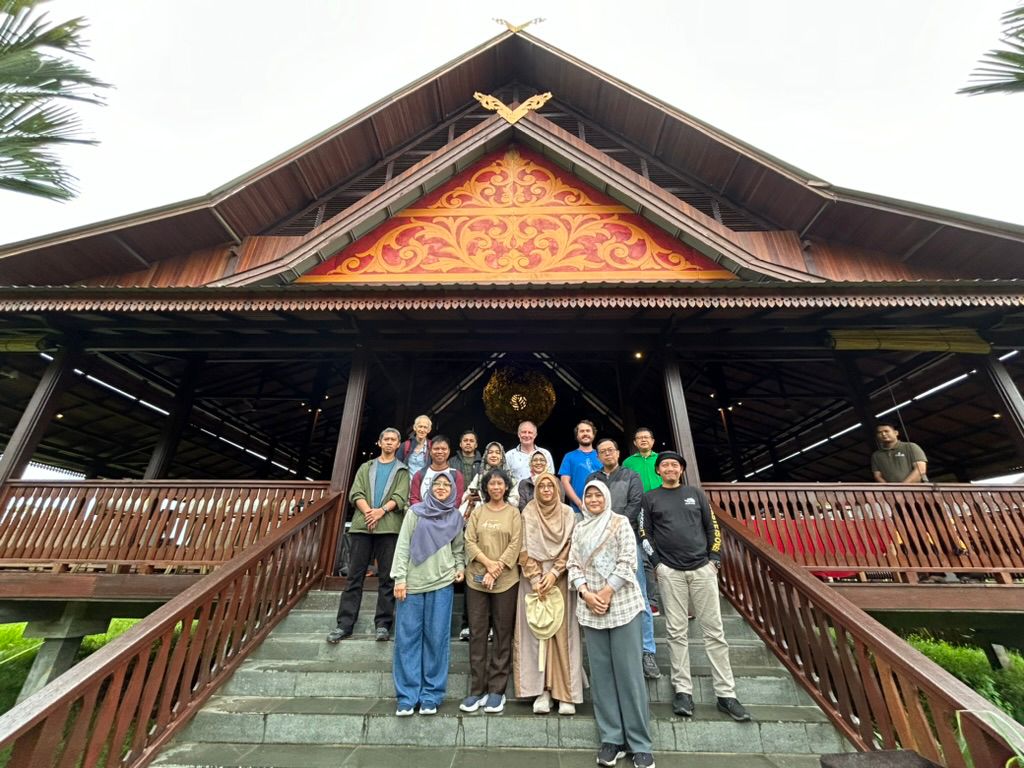
At the end of April 2024, the Gambut Kita team visited the Restorasi Ekosistem Riau (RER) project in Sumatra. It was an opportunity for the units in the research team to update each other on their progress of creating a roadmap for peatland restoration in a setting that is very much related to it. RER was established in 2013 by Asia Pacific Resources International Holdings Limited (APRIL), one of the largest pulp and paper manufacturers in the world. Initially, the Ministry of Forestry granted an ecosystem restoration concession (ERC) license for 20,265 ha of peat forest. Prior to the launch of the ERC, the area had suffered years of degradation since the 1970’s from commercial and illegal logging, drainage canals that lowered the water table and uncontrolled fires to clear land for agriculture.
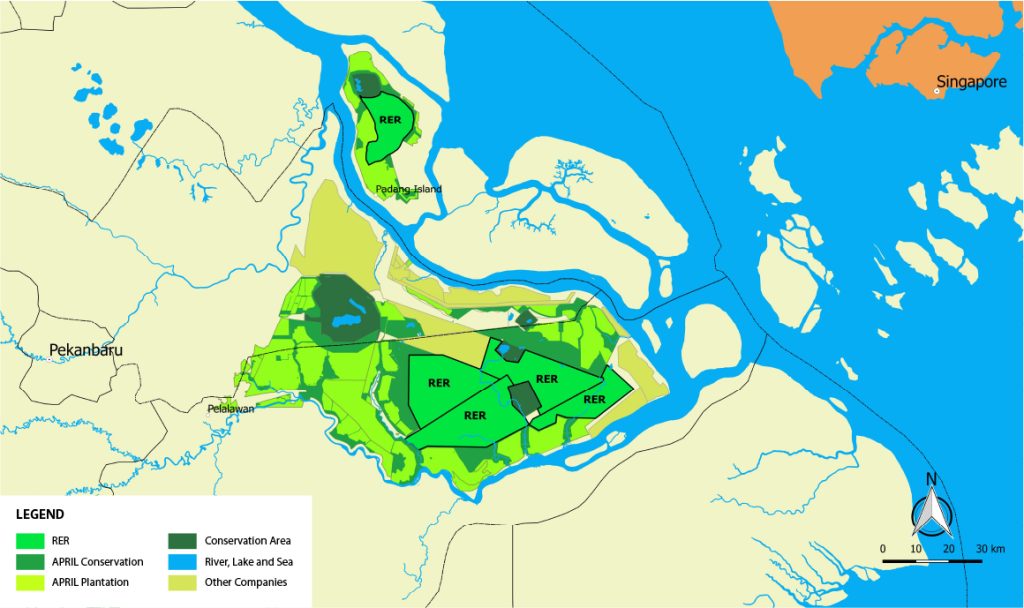
In 2015 at COP21, APRIL announced that they will commit US$100 million to the conservation and restoration efforts of RER over a 10 -year period and that they have expanded RER to 150,693 ha, which consists of three concession areas in the Kampar Peninsula, forming one continuous forest, and one on Padang Island. As seen in the map below, RER is mostly surrounded by plantations which serve as a buffer zone against human disturbances to the restoration area.
Achievements
In the decade since its establishment, RER has had several milestones. One of them was a forest health assessment in 2019 using the Normalised Differential Vegetation Index (NDVI). It measures the photosynthetic capacity of a forest by measuring the ratio of visible light absorbed to near infrared light that is reflected by the leaves. Yearly monitoring from 2012 to 2018 indicates that the forest became greener since it was managed by RER. To accelerate the natural regeneration of heavily degraded forest areas, seedlings from the surrounding forests are kept in a nursery and transplanted to the site when they reach a certain height. Monitoring the plants and animals that inhabit the forest is an important component of restoration. In March 2020 a Sumatran tiger was rescued from a trap, rehabilitated and successfully released back to the wild. This was a collaborative effort between APRIL and the Ministry of Environment and Forestry. Another milestone was a baseline study of its biodiversity in 2021 by Flora and Fauna. A total of 846 species were identified, and later increased to 861 in 2023. Also in 2021, a carbon project on the Kampar Peninsula was validated and registered as one of the largest carbon emission avoidance projects in the world. An estimate of 373 million tons of carbon emissions would be avoided in the 57-year lifetime of the project. This is only achievable provided that the efforts to restore the peatland continues. One of them is rewetting the peat domes, which involves blocking canals to maintain and increase the water table of the peat. To date, RER has achieved 80% of its goal with the installation of 112 dams to block 36 canals that have a total length of 179 km. As fire prevention is equally important, the restoration area is extensively monitored to get early detection of smoke and fire for a rapid response. Since 2014, there have been zero fire incidents in the RER area in the Kampar Peninsula, however firefighting teams are regularly drilled to ensure their preparedness.
Keys for Success
The success of RER is attributed to the fact that APRIL is in charge of the concession area and, being a multinational company, they have an abundance of resources, with a budget of USD 5 million dollars per year. They implement a unique production-protection approach, where the sustainably-managed plantations that lie in the perimeter of the RER financially support the restoration project. Whereas in other cases, efforts to restore an area of peatland is hampered by conflict of interests between stakeholders (eg. company concessions, communities and local government) and there are limited human resources to enforce rules. RER works together with the 40,000 people living in the villages around the concession area, ensuring that their livelihoods go hand-in-hand with the restoration work and that they understand the economic and social benefits of conserving the peat forest. Local farmers that formerly used slash and burn methods are trained in no-burn farming practices, using agroforestry demonstration plots that show how to increase yields sustainably on limited land.
No project of this scale is possible without the support and cooperation of researchers, rangers, local community and government each sharing one goal of maintaining and restoring a peat forest ecosystem. For 11 years, RER has successfully carried out community engagement and empowerment, biodiversity monitoring and landscape management, partnering with BIDARA, Laskar Alam Foundation, Tropenbos Indonesia, Wildlife Conservation Society and The Nature Conservancy. RER sets an example of a successful peat ecosystem restoration model that can possibly be replicated by other extractive industries —maybe in other types of ecosystems— provided that all stakeholders have the same vision and understanding.